Geotechnicalengineering1
ORANGE CALIFORNIA
HomeInvestigationSondaje SPT (Standard Penetration Test)

SPT (Standard Penetration Test) in Orange California

Knowledgeable. Thorough. Resourceful.

LEARN MORE

Our drill rig for SPT in Orange California is a truck-mounted CME 75, equipped with a 140-pound safety hammer and a 2-inch split-spoon sampler. We advance boreholes using continuous flight augers through the alluvial deposits typical of the Santa Ana River floodplain. The hammer drops 30 inches per blow, and we record N-values every 6 inches. This setup allows us to capture consistent penetration resistance in both the sandy terrace deposits and the older Pleistocene formations underlying the city. Before starting any SPT program, we also run a georradar GPR survey to identify buried utilities or obstructions in the urban right-of-way.
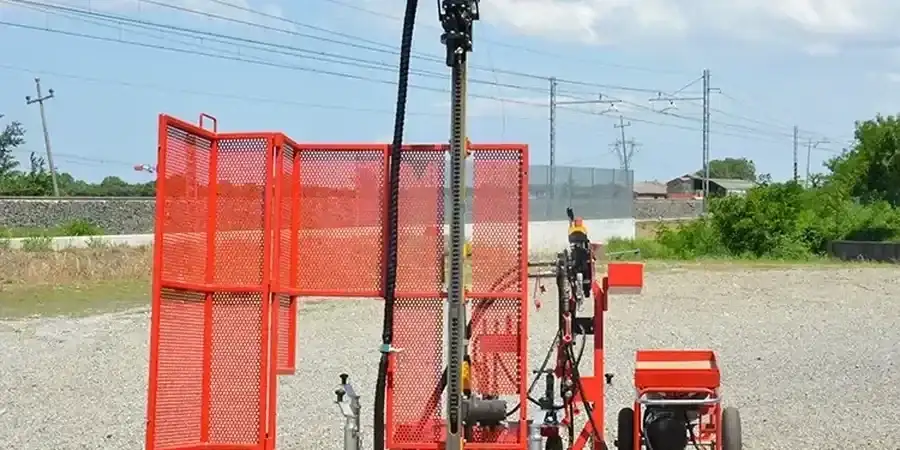
Illustrative image of SPT (Standard Penetration Test) in Orange California
In Orange California, corrected N60 values from SPT are the primary input for both bearing capacity and liquefaction hazard assessment under IBC 2021.

Our service areas

Process overview

Orange California grew rapidly after the 1950s, converting citrus groves into residential subdivisions and commercial corridors. That development pattern means much of the subsurface consists of interbedded sands, silts, and gravels from historic river channels, with occasional clay lenses near the Santiago Creek corridor. For SPT in Orange California, we follow ASTM D1586-18 strictly, using a calibrated trip-hammer system and checking rod lengths to account for energy losses. The N-values we obtain feed directly into bearing capacity calculations per IBC Chapter 18 and into liquefaction triggering assessments using the Youd-Idriss 2001 method.
  • Hammer energy ratio verified with a Pile Driving Analyzer (PDA) before each project
  • Split-spoon liners removed in the field for continuous soil classification per ASTM D2487
  • Borehole logging includes SPT blow counts, groundwater observations, and visual-manual description
Technical reference — Orange California

Local context

The contrast between the Old Towne Orange area underlain by dense older alluvium and the newer subdivisions near the Santa Ana River with loose young sands creates very different SPT profiles. In the river-adjacent zones, N-values in the upper 15 feet often fall below 10 blows per foot, indicating loose sands susceptible to liquefaction during a moderate seismic event. Further east near the Santiago Hills, the same depth interval shows N-values between 25 and 40, reflecting stiffer Pleistocene deposits. Our SPT in Orange California must capture this lateral variability to avoid overestimating soil strength on one lot while underestimating it on the adjacent parcel.

Need a geotechnical assessment?

Reply within 24h.

Email: contact@geotechnicalengineering1.biz

Regulatory framework


ASTM D1586-18, AASHTO T-206, IBC 2021 Chapter 18, ASCE 7-22 Section 11.4 (Site Class)

Technical parameters

ParameterTypical value
Borehole diameter4 to 6 inches (HQ or NQ size)
Split-spoon sampler2-inch OD, 1.375-inch ID, 24-inch length per ASTM D1586
Hammer weight and drop140 lb (63.5 kg) at 30 in (762 mm) free fall
Blow count recordingN1 (0-6 in), N2 (6-12 in), N3 (12-18 in); N = N2+N3
Sampling intervalEvery 5 ft (1.5 m) or at every lithologic change
Energy correctionCE measured via PDA; N60 = N × (ER/60)

Q&A


What is the difference between N-value and N60 in the SPT?

The raw N-value recorded in the field depends on the hammer efficiency, rod length, borehole diameter, and sampler condition. N60 corrects the raw N-value to a reference energy ratio of 60%, which is the industry standard for most design correlations. Our lab measures the actual hammer energy with a PDA and applies the correction per ASTM D1586, so that the N60 value used in bearing capacity or liquefaction analyses is consistent with national databases.

How much does an SPT test cost in Orange California?

For a standard SPT borehole to 30 feet depth with sampling every 5 feet, the typical cost ranges between US$610 and US$790 per borehole. This includes mobilization within Orange California, drilling, sampling, field logging, and delivery of a certified report with N60 values and soil classification. The final price may vary depending on the total number of boreholes, site access conditions, and the need for groundwater monitoring.

What is the maximum depth achievable with SPT in Orange California's soils?

In the alluvial sands and gravels common across Orange California, we routinely reach 50 to 80 feet with a truck-mounted rig. In the older Pleistocene deposits near the Santiago Hills, the dense layers can limit advancement, and we may switch to a rotary wash method to maintain penetration below 80 feet. The practical limit depends on groundwater conditions and gravel content; we assess this during the pre-drill utility clearance and adjust the drilling technique accordingly.

Location and service area

We serve projects across Orange California.

Location and service area